ABOUT THE PAINTING
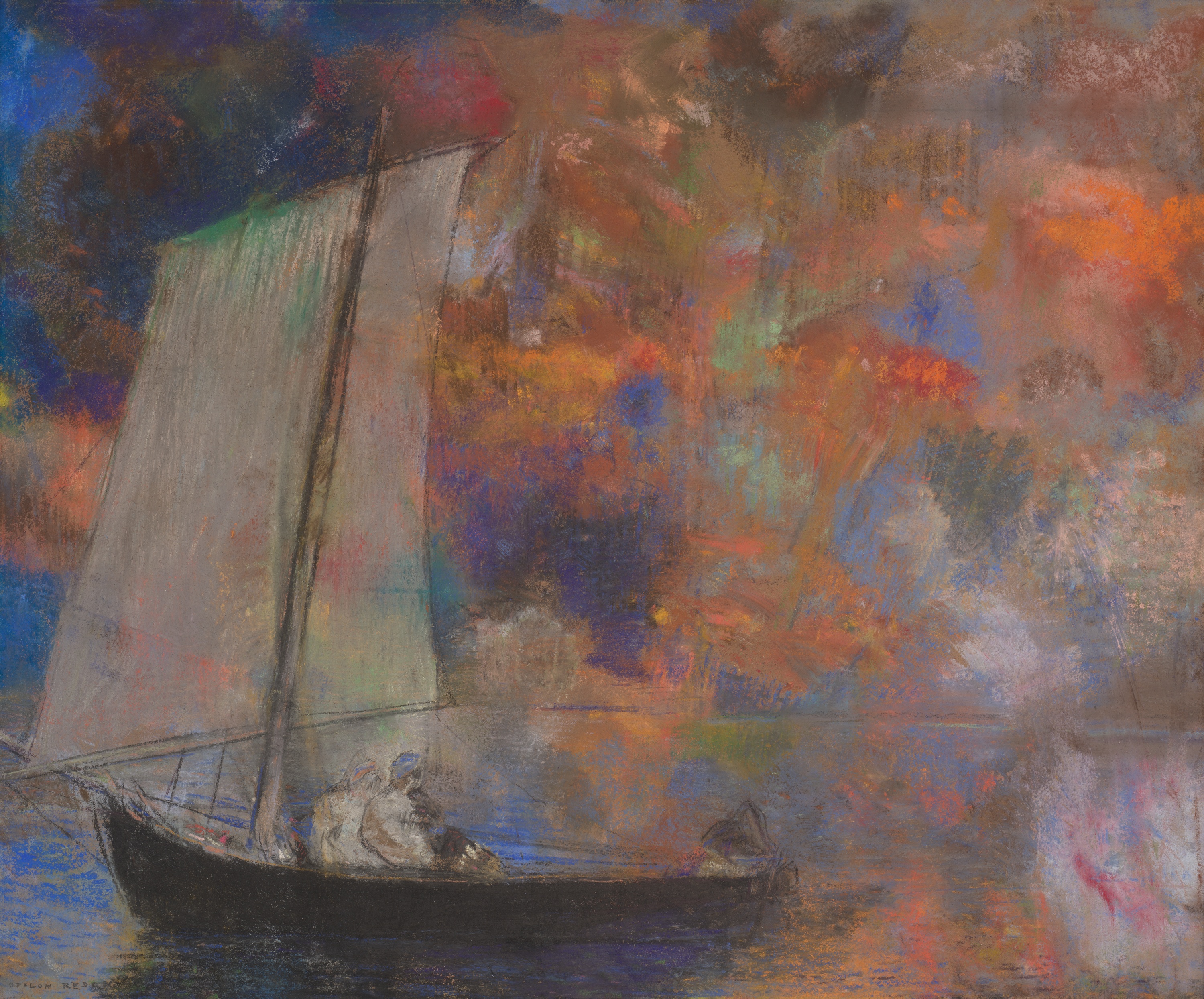
Odilon Redon Flower Clouds 1903 Pastel, with touches of stumping, incising, and brushwork, on blue-gray wove paper with multi-colored fibers altered to tan, perimeter mounted to cardboard 44,5 × 54,2 cm Credits: Art Institute Chicago; Through prior bequest of Mr. and Mrs. Martin A. Ryerson Collection "Flower Clouds" is one of the most luminous and spiritually evocative works created by the French Symbolist artist Odilon Redon. Created around 1903 during the later period of his life, the painting reflects a profound transformation within the artist himself — a movement away from darkness and toward light, color, tenderness, and spiritual openness. Redon was born in Bordeaux in 1840 and spent much of his childhood in relative solitude in the countryside of Peyrelebade. Sensitive, introspective, and deeply imaginative from an early age, he became fascinated not only by art, but also by literature, music, dreams, science, and the mysteries of the inner mind. These influences shaped the intensely personal and visionary quality of his art. For many years, Redon worked almost exclusively in black charcoal and lithography, creating haunting dream-images known as the Noirs. These works explored fear, melancholy, the subconscious, and strange inner visions: floating eyes, mysterious creatures, shadow-like faces, and symbolic apparitions. Influenced by writers such as Edgar Allan Poe and Charles Baudelaire, Redon became one of the great pioneers of Symbolism — an artistic movement that sought to express inner states of the soul rather than external reality. Yet in the 1890s, after decades immersed in darkness, something changed in Redon’s work. He discovered the expressive power of color, especially through pastel. This transition was not merely technical — it was spiritual and emotional. His later paintings seem illuminated from within, as though the artist had emerged from a long interior night into a world of radiance and hope. "Flower Clouds" belongs to this luminous late period. The painting presents a dreamlike boat gliding silently across a glowing sea beneath fantastical clouds that resemble flowers blossoming in the sky. The clouds dissolve into shimmering oranges, golds, blues, and rose-colored light, creating an atmosphere that feels suspended between dream and revelation. The sea itself appears phosphorescent, almost cosmic, reflecting not only light but emotion and spiritual longing. Inside the small sailboat sit delicate human figures — perhaps women, perhaps spiritual travelers, perhaps symbolic aspects of the soul itself. They do not struggle against the water. Instead, they seem carried gently forward through an infinite inner universe. This sense of surrender and quiet transcendence is central to the work. Redon does not paint an actual landscape; he paints a state of consciousness. The soft pastel technique contributes powerfully to this effect. The colors appear almost weightless, dissolving into one another like thoughts, memories, or emotions before they fully take form. The boundaries between sky and sea, dream and reality, self and world begin to disappear. Everything flows into everything else. In this way, "Flower Clouds" becomes less a picture to analyze and more an experience to enter. The work reflects one of Redon’s deepest artistic beliefs: that true art should awaken the inner life of the viewer. Rather than depicting material reality, Symbolist artists sought to evoke mystery, spirituality, emotion, and the invisible dimensions of existence. Redon once said that his art was intended to place “the logic of the visible at the service of the invisible.” That invisible world permeates "Flower Clouds". The painting feels meditative, almost sacred. Its beauty is not decorative but transformative. It invites contemplation, stillness, and emotional openness. The viewer is not simply asked to look at the painting, but to feel it inwardly. Seen in the context of Redon’s life, the painting becomes even more moving. After decades exploring darkness, uncertainty, and inner turmoil, his later works reveal a newfound trust in light, beauty, tenderness, and spiritual harmony. "Flower Clouds" seems to embody this transformation — as though the soul, after wandering through shadow, had finally rediscovered hope. Today, the painting remains one of the most poetic achievements of Symbolist art. It continues to captivate viewers not through narrative or realism, but through atmosphere, color, and emotional resonance. Like a dream remembered from another world, "Flower Clouds" opens a quiet doorway into the depths of imagination, feeling, and the human soul itself.