ABOUT THE PAINTING
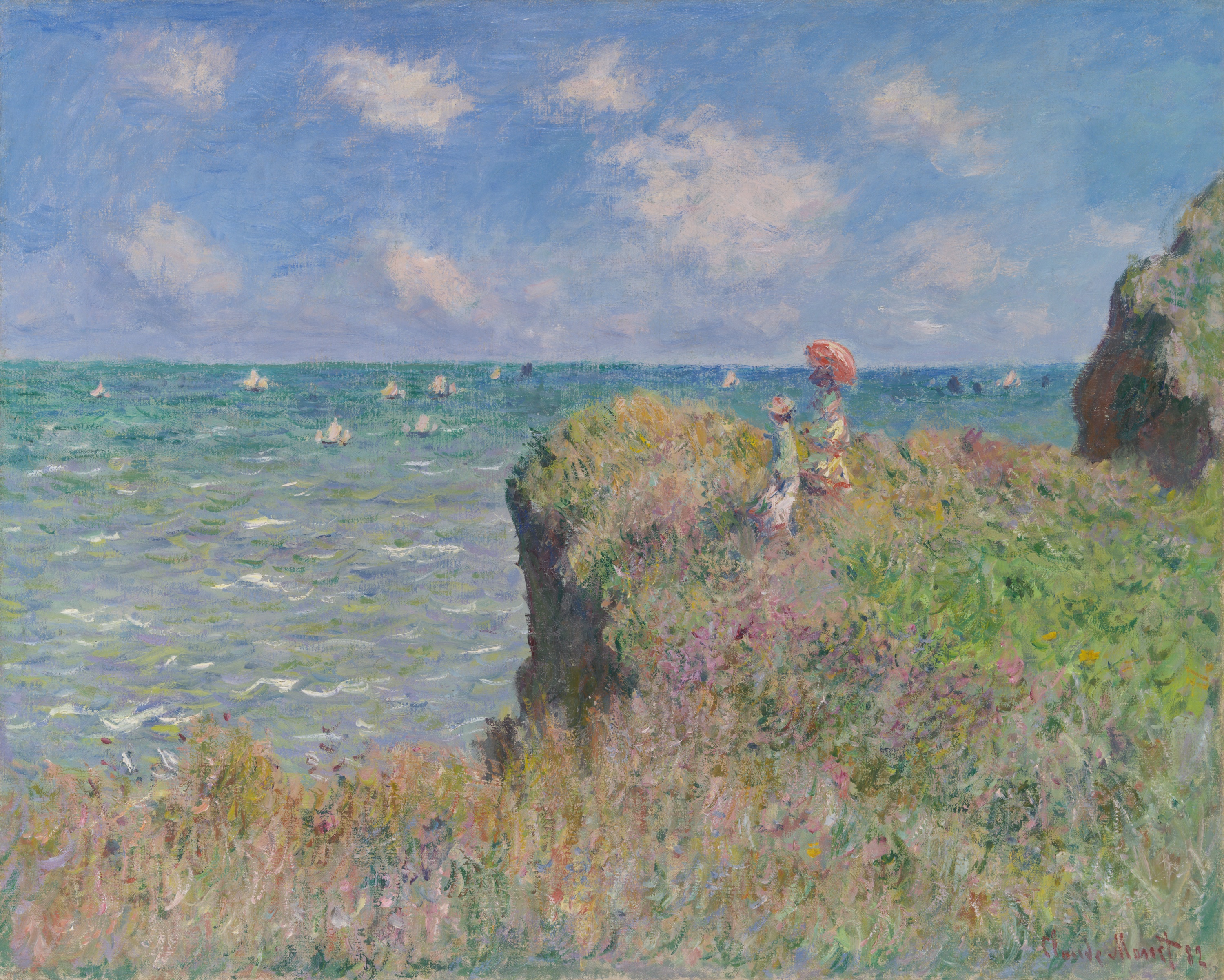
Claude Monet Cliff Walk at Pourville 1882 Artist: Oil on canvas 66.5 × 82.3 cm Credits: Art Institute Chicago; Mr. and Mrs. Lewis Larned Coburn Memorial Collection The Cliff Walk at Pourville was painted in 1882 during a period in which Claude Monet spent several months on the Normandy coast in the small fishing village of Pourville-sur-Mer. At the time, Monet was searching for distance from both financial difficulties and personal grief following the death of his wife Camille a few years earlier. The dramatic coastline, changing weather, and luminous sea air of Normandy became a source of renewed artistic inspiration for him. The painting captures two elegantly dressed women walking along a grassy cliff high above the English Channel on a bright summer day. Far in the distance, small fishing boats appear on the horizon, creating a subtle contrast between leisure and everyday labor. While the women enjoy the beauty of the coastline, the fishermen continue their work at sea, quietly reminding the viewer of the different worlds that coexist within the same landscape. Many art historians believe the figures may have been inspired by members of Monet’s close circle, possibly Alice Hoschedé and her daughters, who often accompanied him during this period. Yet the figures are painted with enough openness and anonymity that they feel almost universal — less like portraits and more like fleeting presences carried by the wind and sunlight of the moment. One of the most striking aspects of the work is Monet’s brushwork. Rather than carefully outlining forms, he used loose, energetic strokes to suggest movement everywhere in the scene: the swaying grass, the flowing dresses, the shifting clouds, and the restless surface of the sea. The entire landscape appears alive and in motion, as if the viewer has stepped into a passing instant shaped by light and wind. The composition itself enhances this sensation of immediacy. The cliffs rise diagonally across the canvas, guiding the eye outward toward the open water and sky. Instead of using strict linear perspective, Monet creates depth through overlapping planes, soft atmospheric transitions, and subtle changes in color and light. This gives the painting its airy, almost dreamlike quality. Although the scene appears spontaneous and effortless, Monet carefully refined the balance of the composition while working on the canvas. Technical studies have shown that he altered parts of the cliffs and even removed a third figure from the painting, allowing the final version to feel more open, harmonious, and quietly contemplative. Today, the painting is celebrated not only as a beautiful coastal landscape, but also as an example of Monet’s ability to capture the fleeting emotional atmosphere of a moment — the warmth of sunlight, the movement of the sea breeze, and the fragile beauty of a summer afternoon suspended in time.